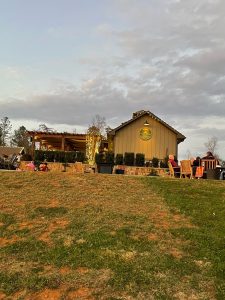
We’re featuring another Best of Cork Talk episode, this time we look back at our conversation with Sofia Lily at Overmountain Vineyards in Tryon, NC! We catch up on how the tasting room has evolved over the past 5 years to enhance your experience when you visit. Wine quality continues to be a focus and Sofia talks to us about how they continue to push boundaries.
During our recap conversation, we also discussed the impact of Hurricane Helene to Western North Carolina and how Sofia and Overmountain Vineyards were involved in the recovery efforts. Sofia partnered with a nearby dairy, Big Bottom Milk Company to switch over to bottling fresh water for anyone who needed. Through their efforts they eventually turned into a support hub for the region.
If you like this episode, please leave us a rating and review. It really helps spread the word. Subscribing and sharing with a friend is another great way to support Cork Talk.
This episode was made possible in part by a grant from the North Carolina Wine and Grape Council. For more information, please visit https://www.ncwine.org
In this episode of Cork Talk, we explore the impact of Hurricane Helene on North Carolina’s wine industry. Hear firsthand stories of resilience and recovery from local wineries and vineyards. Discover how the community has faced challenges and adapted in the aftermath of the storm. Join us for an inspiring look at the strength and determination of North Carolina’s wine industry.
Wine Class with the Wine Mouths is back again! Join us as they talk about Hydrometers! For more information about the Wine Mouths, head to https://www.winemouths.com/ or find them on Facebook, Instagram and TikTok @Winemouths. The Wine Mouths theme was written and performed by Joshua Morris. You can find him at twitter.com/joshtimejosh.
If you like this episode, please leave us a rating and review. It really helps spread the word. Subscribing and sharing with a friend is another great way to support Cork Talk.
This episode was made possible in part by a grant from the North Carolina Wine and Grape Council. For more information, please visit https://www.ncwine.org
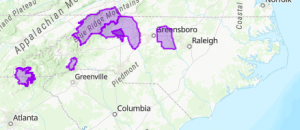
Current American Viticultural Areas in North Carolina
In the Wine Light we continue our series on American Viticultural Areas (AVAs) in North Carolina. Our focus in this post is the newest and seventh AVA in North Carolina, Tryon Foothills AVA. Tryon Foothills AVA (according to the TTB) was formally approved effective October 29, 2025, and is located in eastern Polk County, NC including the community of Tryon.
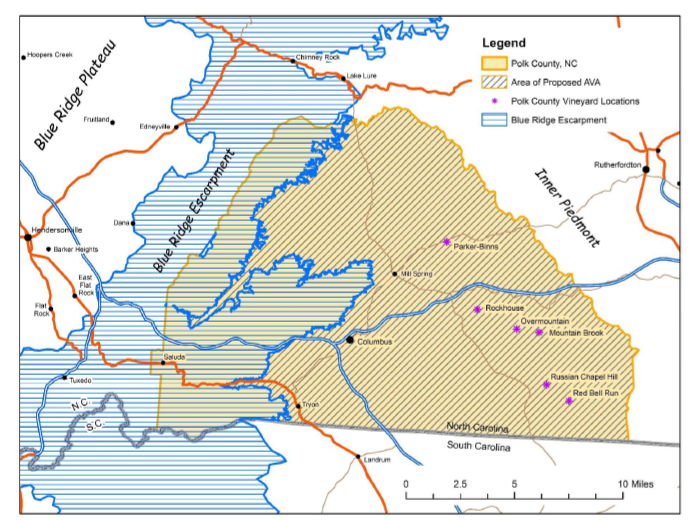
Proposed Tryon Foothills AVA in Polk County, NC
Tyron Foothills AVA
The petition for creating the Tryon Foothils AVA originated from Cory Lillberg of Parker-Binns Vineyard and Winery and Joseph Forrest on behalf of Polk County vineyard and winery operators. This new AVA consumes the eastern two thirds of Polk County, east of the Blue Ridge Escarpment.
Parker-Binns Vineyard & Winery – Mill Spring, NC
The Tryon Foothills AVA is distinguished from the surrounding areas and other AVAs due to topography and climate. At the time of the petition to establish the AVA, there were 5 vineyards and 4 wineries within the boundaries of the AVA.
Behind the Name
The name Tryon Foothills was chosen since the area has been referred to “Tryon Foothills” for many years. The area sits at the foothills of the nearby Blue Ridge Mountains and starting in the 1890s to as late as the 1940s, the area was well known for being a grape growing region. The Isothermal Belt, a climatic zone, of Polk and neighboring Rutherford County contributed to moderating temperatures. According to the AVA petition, this feature “along with well-drained mountain slopes, southern hillside exposure, and deep, rocky soils provides an ideal terroir” for grape growing. The famous “Tyron Grapes” were sold to travelers at the local train station in Tryon and were so famous that they were featured on menus at the Waldorf Astoria Hotel in New York City.
As rail travel declined and California continued its viticulture expansion, the Tryon vineyards declined and disappeared. Then in 1991, Lee Griffin and his wife, Marsha Cassedy, planted a small vineyard for their personal use. It was very successful, so it was expanded to 10 acres and was known as Rockhouse Vineyard until it closed in 2020. In 1998, Joe and Jeanne Mize planted a 30 acre vineyard in the Green Creek community of Polk County. Other vineyards followed with 5 currently growing in the proposed Tryon Foothills AVA.
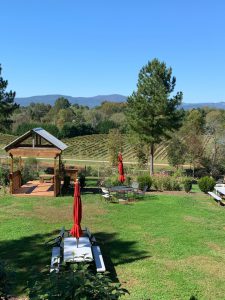
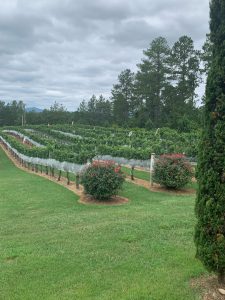
Overmountain Vineyards – Tryon, NC
Distinguishing Features
Per the petition, the Tryon Foothills AVA “is in the low mountains and rolling hills of the Inner Piedmont of Western North Carolina.” The Blue Ridge Escarpment rises steeply to the west of the AVA. Areas east and south of the AVA see elevations that gradually decrease.
Mountain Brook Vineyards – Tryon, NC
The growing season averages between 200 and 210 days within the AVA. This is shorter than the growing season to the south and east of the AVA but longer than the growing season to the north and west of the AVA. Annual precipitation is higher than regions to the south, northeast, and northwest of the AVA but lower than the region west of the AVA.
The Tyron Foothills area is a wonderful tourist destination that’s often less busy than other parts of the state. Although that has changed a bit in recent years. The AVA is producing some outstanding wines including wonderful Petit Mansengs, Cabernet Francs, Petit Verdots, and Cabernet Sauvignons. Cabernet Sauvignon sees the largest planting followed closely by Merlot. In addition to wine, the Tyron International Equestrian Center provides many events throughout the year. Be sure to go visit the Tryon Foothills and see for yourself.
Quick Facts
Name: Tryon Foothills AVA
Petitioner: Cory Lillberg and Joseph Forrest on behalf of Vineyard and Winery Operators of Polk County, NC
Effective Date: October 29, 2025
Square Miles: 176
Counties within boundaries: Eastern Two-Thirds of Polk County, NC – east of the Blue Ridge Escarpment
Geography: Elevation ranges from 712 ft to over 1656 ft with average elevation of 988 ft
Climate:The average annual temperature is 59.2 degrees with a growing season that averages 200 – 210 days.
Source: Petition submitted by Cory Lillberg and Joseph Forrest